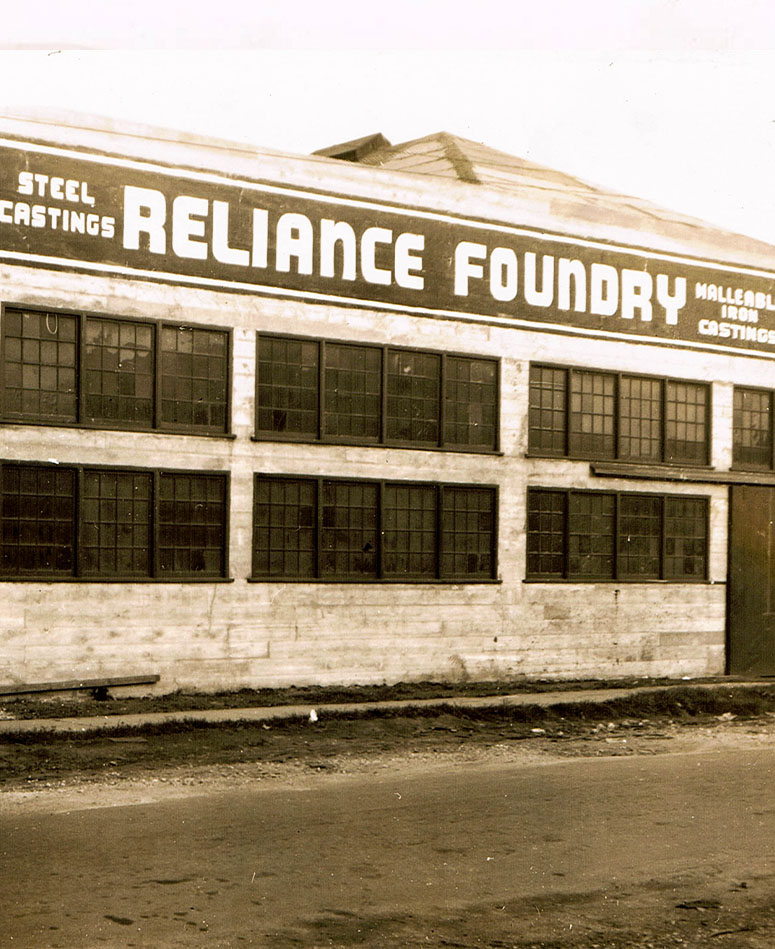
CASTING ORDERING BACKGROUND INFORMATION
|
| |
Casting Price Quotations; How to Order Steel Castings
The ordering of steel castings takes a certain
amount of time and energy to qualify a potential supplier foundry.
To get the best value from the steel casting also requires a cooperative
effort on the part of the customer and the supplier foundry from the
early stages of the design through to the end manufacturing process.
Good planning ahead of time will pay dividends for both you (the customer)
and your supplier foundry.
The purpose of requesting a quotation for a steel
casting is basically to determine the lowest purchased casting cost.
The customer then must weigh all of the provisions of the quotation
including exceptions taken to drawings, specifications, and processing
requirements, as well as supplier foundry experience, tooling requirements,
tolerances, finish allowances, and delivery. Such factors as reduced
machine work, better tolerances, improved delivery schedules and
reliability are particularly important to determine the lowest end
cost of the casting.
To avoid misunderstandings, reduce costs, and expedite the processing of quotations, all or some of the following
information should be included in a request for a quotation:
|
| |
Design
- What is the part? See DESIGN below.
Quantity - What is the anticipated or required volume, both present and future?
Material and inspection requirements; what should the part be made of, and
how should the part be tested before delivery? ASTM or other nationally recognized specifications should be used whenever possible
to identify the material and inspection requirements. See MATERIAL SPECIFICATIONS and
SOUNDNESS below.
Actual
or estimated casting weight. Actual weight information is preferred. Estimates can be provided by the supplier foundry
in the absence of actual weight information, but this may require offering prices that are subject to changes based on the actual
weight of the casting(s) in question at the time of production.
Drawing.
Machine drawings are preferred over casting drawings. Drawings or
sketches are mandatory if samples or patterns are not
available. Drawing should include dimensional tolerances, indications
of critical areas and surfaces to be machined. See MACHINING below.
Pattern.
If patterns and core boxes are available, the request for a quotation
should indicate the type, condition and set up of the equipment. See PATTERNS below.
Production/delivery schedules required. Present and anticipated need should be included
in quotation requests.
|
| |
Beyond these basics,
there are levels of customer requirements that could include supplier
foundry liabilities, which affect the casting cost drastically. These
could include receiving inspection acceptance and back charge policy,
casting return policy, expediting procedures, and sophisticated controls
not normally associated with the standard inquiry. A complete understanding
of these areas is best developed by an open relationship between the
customer and the supplier foundry representative, and the professional attitudes and experiences that both can provide during the quotation
evaluation phase.
DESIGN
To achieve the most efficient production and the highest quality product,
the part should be designed to take advantage of the flexibility of
the casting process. The supplier foundry must have either the designer's
drawings or pattern equipment and know the length of the run (number
of parts to be made).
Castings are generally furnished with un-machined
as-cast surfaces, unless otherwise specified. To take advantage of
the casting process, the supplier foundry should also know which surfaces
are to be machined and where datum points are located. The acceptable
dimensional tolerances must be indicated when a drawing is provided.
Tolerances are normally decided by agreement between the supplier
foundry and customer. Close cooperation between the customer's design
engineers and the supplier foundry is essential to optimize the casting
design.
BACK TO TOP OF THE PAGE
MATERIAL
SPECIFICATIONS
Industry standard specifications provide the casting customer with
the tools necessary to establish criteria for almost any casting application. These specifications do not preclude special requirements that the
customer's technical staff members may require. Variations from standard
specifications can result in misunderstandings, higher costs and disqualification
of potential supplier foundries. If exception is taken to a provision
in the main body of a specification requirement (as opposed to taking
exception to a supplemental requirement of a specification), the resulting
casting cannot be held to compliance with that specification.
Mechanical properties may be verified by the use of test bars cast
either separately or attached to the castings. The mechanical properties
obtained represent the quality of the steel, but do not necessarily
represent the properties of the castings themselves, which are affected
by solidification conditions and rate of cooling during heat treatment,
which in turn are influenced by casting thickness, size and shape.
In particular, the harden ability of some grades may restrict the
maximum size at which the required mechanical properties are obtainable.
Short of destructive testing of an actual casting sample, the use
of a test bar is the best measure of the steel quality.
BACK TO TOP OF THE PAGE
SOUNDNESS
Soundness of metal components refers to the level of freedom from
impurities and/or discontinuities such as sand inclusions, slag inclusions, macro porosity, and shrinkage.
Steel castings begin to solidify at the mold
wall, forming a continuously thickening envelope as heat is dissipated through the mold-metal interface. The volumetric contraction that
occurs within a solidifying cast member must be compensated by liquid
feed metal from an adjoining heavier section, or from a riser which
serves as a feed metal reservoir and which is placed adjacent to,
or on top of, the heavier section. The lack of sufficient feed metal to compensate for volumetric contraction at the time of solidification
is the cause of shrinkage cavities. They are found in sections which, owing to design, must be fed through thinner sections. The thinner
sections solidify too quickly to permit liquid feed metal to pass
from the riser to the thicker sections.
Testing ensures that the material meets the requirements of the specification;
consequently, testing may be mandatory. More frequent testing or other tests may be imposed, by use of supplementary requirements of material
specifications or general requirement specifications. In addition to specifying test methods, acceptance criteria must be agreed upon
between the purchaser and the foundry. The more testing and tighter
the acceptance criteria the more expensive the product will be - without
necessarily increasing quality or serviceability. Hence, the extent
of testing and acceptance criteria should be based on the design and
service requirements.
|
| |
It is impossible to produce
a defect free casting, only castings with defects of varying degrees
of acceptability. The acceptance and/or rejection of such castings
can only be determined by examination and analysis of parts (in accordance
with internationally recognized standards such as ASTM) based on customers'
formal engineering requirements. A defect in one application may not be a defect in another application and it is impossible to make a
casting without some kind of flaw. The size of flaw(s) can vary significantly,
and what is acceptable and what is defined as a REJECTABLE defect
depends on agreement between the supplier foundry and the client prior
to production. Large cavities often exist in thick-section castings
and can be perfectly acceptable depending on the application and the
location within the casting. On the other hand, some applications
are very critical and tiny flaws (or even micro-porosity - as defined
by a specific NDT process and acceptance/rejection level) may be considered
as defects that may be detrimental to the intended use of the product.
Acceptance and rejection criteria for castings production must be
determined at the time of quotation and certainly at the time of order,
as such criteria affect the price of castings, as well as the production
procedures and processes used to produce the castings.
BACK TO TOP OF THE PAGE
PATTERNS Pattern equipment design and the resultant costs can constitute a
major source of misunderstanding between customer and supplier foundry.
The need to construct new pattern equipment when existing equipment
is available, a requirement for a full split core box in place of
a half core box, pattern material, and mounted or loose patterns are but a few of the many areas of discussion that effect the cost of
the equipment. Invariably, the lowest casting cost and highest casting
quality evolve from the more sophisticated pattern equipment, which
generates the highest pattern cost.
BACK TO TOP OF THE PAGE
Minimum
Section Thickness
The rigidity of a section often governs the minimum thickness to which
a section can be designed. There are cases, however, when a very thin
section will suffice, depending upon strength and rigidity calculations,
and when castability becomes the governing factor. In these cases
it is necessary that a limit of minimum section thickness per length
be adopted in order that liquid metal will completely fill the mold cavity in these thinner sections.
Molten steel cools rapidly as it enters a mold. In a thin section, close to the gate, which delivers the hot metal,
the mold will fill readily. At a distance from the gate, the metal
may be too cold to fill the same thin section. A minimum thickness of 0.25 in (6 mm) is suggested for design use when conventional
steel casting techniques are employed. Wall thicknesses of 0.060 in (1.5 mm) are common for investment castings and sections tapering
down to 0.030 in (0.76 mm) can readily be achieved.
BACK TO TOP OF THE PAGE
Draft
Draft is the amount of taper (or the angle) which must be allowed
on all vertical faces of a pattern to permit its removal from the
sand mold without tearing the mold walls. Draft should be added
to the design dimensions while maintaining minimum metal thickness.
Regardless of the type of pattern equipment used,
draft must be considered in all casting designs. (Draft can be eliminated
by the use of cores; however, this may add significant cost.) In
cases where the amount of draft may affect the subsequent use of
the casting, the drawing should specify whether this draft is to
be added to or subtracted from the casting dimensions as given.
The necessary amount of draft depends upon
the size of the casting, the method of production, and whether molding is by hand or machine. Machine molding will require a minimum amount
of draft. Interior surfaces in green sand molds usually require
more draft than exterior surfaces. The amount of draft recommended
under normal conditions is about 3/16 in. per ft. (approximately
1.5 degrees), and this allowance would normally be added to design dimensions.
BACK TO TOP OF THE PAGE
Parting
Line
Parting in one plane facilitates the production of the pattern as
well as the production of the mold. Patterns with straight parting
lines (that is, with parting lines in one plane) can be produced
more easily and at lower cost than those with irregular parting
lines. Casting shapes which are symmetrical about one center line
or plane readily suggest the parting line. Such casting design simplifies
molding and coring, and should be used wherever possible. They should
always be made as "split patterns" (separate cope and
drag) which require a minimum of handwork in the mold, improve casting
finish, and reduce costs.
BACK TO TOP OF THE PAGE
Cores
A core is a separate piece (often made from molding sand) placed inside the mold to create openings and cavities which cannot be
made by the pattern alone. Every attempt should be made by the design
to eliminate or reduce the number of cores needed for a particular
design to reduce the final cost of the casting.
BACK TO TOP OF THE PAGE
The minimum diameter of a core which can be
successfully used in steel castings is dependent upon three factors:
|
|
| |
The thickness of the metal section surrounding the
core
The
length of the core
The
special precautions and procedures used by the supplier foundry.
|
| |
The adverse thermal conditions to which
the core is subjected increase in severity as the metal
thickness surrounding the core increases, and the core diameter
decreases. These increasing amounts of heat from the heavy section must be dissipated through the core. As the severity
of the thermal conditions increases, the cleaning of the
castings and core removal becomes much more difficult and
expensive.
The thickness of the metal section
surrounding the core, and the length of the core, both affect
the bending stresses induced in the core by buoyancy forces
and, therefore, the ability of the supplier foundry to obtain the tolerances required. If the size of the core is large
enough, rods can often be used to strengthen the core. Naturally,
as the metal thickness and the core length increase,
the amount of reinforcement required to resist the bending
stresses also increases. Therefore, the minimum diameter
core must also increase to accommodate the extra reinforcing.
The cost of removing cores from casting
cavities may become prohibitive when the areas to be cleaned
are inaccessible. The casting design should provide for
openings sufficiently large to permit ready access for the removal of the core.
MACHINING
Tolerance refers to the dimensional accuracy achievable for a given production method. For the green sand casting
process, mold expansion, solidification shrinkage, and thermal contraction all influence the tolerance of the finished
part. Consequently, there are limits for tolerances in an
as-cast part. Subsequent machining is commonly employed when a tighter tolerance is required.
In the final analysis the supplier foundry is responsible for giving the designer a cast product
that is capable of being transformed by machining to meet the specific requirements intended for the function of the part. To accomplish this goal a close relationship must
be maintained between the customer's engineering and purchasing staff and the casting producer. Jointly, and with a cooperative
approach, the following points must be considered:
|
| |
The
casting process, its advantages and its limitations.
Machining
stock allowance to assure clean up on all machined surfaces.
Design
in relation to clamping and fixture devices to be used during
machining.
Selection
of material specification and heat treatment.
Quantity
of parts to be produced.
|
| |
It is imperative that every
casting design, when first produced, be checked to determine whether all machining requirements called for on the drawings
may be attained. This may be best accomplished by having a complete layout of the sample casting to make sure that adequate
stock allowance for machining exists on all surfaces requiring
machining. For many designs of simple configuration that can be measured with a simple rule, a complete layout of the casting
may not be necessary. In other cases, where the machining dimensions are more complicated, it may be advisable that
the casting be checked more completely, calling for target points and the scribing of lines to indicate all machined surfaces.
BACK TO TOP OF THE PAGE
|
|
|
|